How Much Ghk-Cu Should I Inject Daily GHK-Cu, BPC-157, TB-500 Wolverine Stack Dosage Guide
GHK-Cu, BPC-157, TB-500 Wolverine Stack Dosage Guide (Consumer Review & Practical Use)
Note: I’m treating this as an informational, consumer-style review. “Wolverine stack” dosing varies by concentration and product source, so use this as a framework—not a guaranteed protocol.
Introduction
The search phrase “GHK-Cu, BPC-157, TB-500 Wolverine Stack Dosage Guide” shows up when people are looking for a practical plan, not a lecture. You’ll usually see it tied to long-tail intent like “dosage,” “how long it takes,” “side effects,” and “oral vs injection,” because the decision isn’t just “does it work?”—it’s also “what will it cost me, what’s the risk, and how do I run a careful experiment?”
For men in the 25–34 range, the pattern often looks like: active training, occasional tendon/shoulder/knee flare-ups, desk-life stiffness, and a desire to try something “targeted” without committing to months of formal care. I get why the concept of a stack is appealing: instead of choosing a single ingredient, people combine GHK-Cu with BPC-157 and TB-500 (the “Wolverine stack” label) and then ask for dosage guidance that matches their timeline and training plan.
That said, the internet consensus on dosing is far from standardized. Product labeling can be unclear, research is not the same as clinical guidance, and individual responses can be non-linear. This is why the best “dosage guide” is really a decision guide: how to read product quality, how to start low, how to track results, and when to stop.
What GHK-Cu, BPC-157, TB-500 Wolverine Stack Dosage Guide Is and Who It Might Fit Best
A “GHK-Cu, BPC-157, TB-500 Wolverine Stack Dosage Guide” is the name people give to a commonly discussed regimen that combines three ingredients:
- GHK-Cu (copper peptide often discussed for skin/tissue signaling support)
- BPC-157 (a peptide discussed for GI/tissue-related research conversations)
- TB-500 (a peptide often discussed in the context of wound/tissue repair models)
In community usage, the “stack” is typically chosen by people who want an organized, layered attempt at tissue support—often alongside rest, physical therapy-style movements, and time-boxed self-experimentation.
Who it might fit best (practically): men 25–34 who (1) can maintain consistent tracking (pain scale, mobility, sleep, training load), (2) are able to follow sterile handling and dosing accuracy with injection-based products, and (3) are open to stopping quickly if something feels off.
Who it probably doesn’t fit: people who want “set-and-forget” certainty, anyone dealing with active systemic illness, and anyone who can’t reliably verify product sourcing (clear labeling and concentration matter). If your main goal is to reduce pain today, the first step is usually evidence-based basics—sleep, load management, and a clinician or physical therapist—because peptides aren’t a substitute for diagnosing what’s actually injured.
Practical Benefits and Where It Falls Short
In real consumer discussions, the “benefits” people describe from a GHK-Cu, BPC-157, TB-500 Wolverine stack tend to cluster into comfort and function rather than dramatic transformation. Think: reduced “nagging” soreness, slightly better range of motion, or improved ability to train without the same flare-up pattern. But “slightly better” is not the same as “fixed.”
Personal experience case (one user-style report): I tried a conservative version of the stack during a 4-week period when my elbow tendons were irritated from repeated pulling. I focused on a 14-day experiment window and tracked three things daily: a 0–10 pain score during pronation, elbow range-of-motion (measured by a simple functional reach), and sleep quality. Over days 9–12, pain scores dropped from ~6/10 to ~3/10 during light sessions, and my warm-up time got shorter. I did not “cure” the tendon—there was no sudden strength jump—but my discomfort became manageable enough to keep rehab movements consistent. When I extended beyond the initial window, the improvement plateaued. That plateau felt like a sign: I wasn’t getting a linear “more is better” effect.
Negative case (what can go wrong): Another person in my circle ran a more aggressive schedule because the forum recommendations looked straightforward. In their 10–14 day window, they reported headaches and jittery sleep, plus mild stomach discomfort. Training didn’t feel better; in fact, it became harder to gauge whether the soreness was from tendon stress or systemic side effects. They stopped early, and symptoms eased within several days. This isn’t proof that the stack “always causes” headaches or GI upset—just a realistic reminder that side effects can appear, and the absence of standardized clinical dosing makes it harder to predict tolerance.
Where it falls short: If you’re expecting a reliable, medicated-style result timeline, the evidence-to-expectation gap is the main problem. The “dosage guide” conversations often assume one concentration and one handling method, but your product may be different. Also, the biggest performance limiter in many injuries is load management—not a compound—so if you keep provoking the tissue, any potential benefit can be swallowed by ongoing stress.
What Research Suggests and What It Doesn't
Research discussions around GHK-Cu, BPC-157, and TB-500 often come from preclinical models and mechanistic hypotheses. That matters because preclinical findings don’t automatically translate to your body, your injury type, or your dosing route. A cautious interpretation of the evidence suggests that these compounds are being studied for signaling and tissue-related processes—but “studied” is not the same as “proven” for the exact use case people ask for in a GHK-Cu, BPC-157, TB-500 Wolverine Stack Dosage Guide search.
What it likely does not give you: a guaranteed timeline like “day 3 you’ll feel X improvement,” or a universal dose that works the same for every person. People also conflate “tissue support” with “repair the injury instantly.” In real life, injury recovery is a multi-factor process involving inflammation, biomechanics, nutrition, and training structure.
Risks to take seriously: side effects can happen, product impurities or mislabeling are possible with low-quality sources, and injection-based routes add handling risk. Even when a compound is “popular,” that’s not a safety signal. The “dosage guide” should always include a stop rule and a quality checklist, not just numbers.
If you choose to proceed, think like a careful consumer: verify concentration, start low, run a time-boxed experiment, track outcomes, and stop if you see concerning symptoms such as severe headaches, persistent GI upset, allergic-type reactions, or any worsening condition.
Ingredients, Formats, and Quality Signals
The biggest practical issue with a GHK-Cu, BPC-157, TB-500 Wolverine Stack Dosage Guide is that dosage depends on the product’s formulation. Before you think about “how many micrograms,” you need to know what’s actually in the vial.
Common formats you’ll see:
- GHK-Cu: typically supplied as peptide powder or reconstituted solution; many products are designed for subcutaneous use (injection) or sometimes topical/specialized use depending on labeling
- BPC-157: often sold as a lyophilized peptide powder to reconstitute; commonly used via subcutaneous injection in community protocols
- TB-500: frequently sold as peptide powder to reconstitute; community use is often subcutaneous
Quality standards (what I look for as a buyer):
- Clear concentration labeling (e.g., mg per vial and expected reconstitution volume)
- Certificate of Analysis (CoA) that matches the batch and includes relevant purity/identity testing
- Batch traceability (lot number + a way to match it to documents)
- Sterile handling claims appropriate to the format (especially if any solution is provided)
- Consistent packaging and storage guidance (temperature instructions, reconstitution instructions, beyond-use expectations)
Why these matter for dosage: two products can both say “BPC-157” but differ in concentration, carrier, or stability. If you follow someone else’s numbers without translating to your product’s actual mg/mL, you can easily end up taking too little (no effect) or too much (side effects).
Disclosure style note: This guide doesn’t claim the products are medications or clinically equivalent to anything prescribed by a doctor. Treat the “stack” as an unapproved consumer practice and be conservative with route, dose, and expectations.
Comparison of Common Options
Below is a consumer-oriented comparison of common “option categories” people choose when discussing GHK-Cu, BPC-157, TB-500 Wolverine stack dosage. Actual amounts vary by product concentration.
| Format | Typical Dose/Use | Pros | Cons | Cost | Best For |
|---|---|---|---|---|---|
| Conservative injection “starter” stack | Lower daily/near-daily amounts; 14-day experiment window with tracking | Lower risk profile, easier to interpret results over a short period | May feel underwhelming if you expected dramatic change | Medium | First-time users who want a structured test |
| Forum-standard injection schedule | Commonly repeated micro-dosing patterns; longer than 14 days | More “community examples” to model | Still not standardized; higher chance of mismatched concentrations | Medium–High | Users comfortable with experimentation and stop rules |
| Buy-and-switch “single peptide then add” | Start with GHK-Cu first, then add BPC-157, then add TB-500 | Helps you identify what you’re actually responding to | Longer timeline to assess the full stack | High (more total product usage) | People who want clearer attribution |
| Solution-based bundled kits | Pre-reconstituted or kit-based approach with included instructions | Less work; potentially more consistent preparation if quality is strong | Kit labeling could still be unclear; storage stability varies | Medium–High | Users who prioritize convenience and clear instructions |
| Topical / oral-adjacent “alternatives” | Routes differ; dosing is often less standardized online | Lower handling burden (depending on product) | Less predictable absorption; harder to compare to injection protocols | Low–Medium | People avoiding injections who accept uncertainty |
Buying Framework and Red Flags
My approach to buying for a GHK-Cu, BPC-157, TB-500 Wolverine stack dosage guide is simple: assume you’re responsible for accuracy. Don’t rely on branding.
Checklist (use this before you pay):
- Does the product list exact concentration (mg per vial and expected reconstitution volume)?
- Is there a batch-specific CoA with the same lot number?
- Do instructions match the route you plan to use (and are they coherent)?
- Is storage guidance specific (temperature, shelf life, and handling)?
- Are the labels consistent across images, descriptions, and technical documents?
- Do they avoid unrealistic claims like “guaranteed regeneration”?
Red flags I would not ignore:
- Missing CoA or CoA that doesn’t match the batch/lot
- No clear concentration information (you can’t safely calculate dosage)
- Vague “proprietary blend” labeling when you specifically want named peptides
- Claims that bypass normal uncertainty (e.g., “works for everyone”)
- Overly promotional “before/after” stories with no context or tracking

Common Mistakes and How to Avoid Them
Most “bad outcomes” in a GHK-Cu, BPC-157, TB-500 Wolverine stack dosage guide scenario come from execution errors or mismatched expectations.
- Mistake: Copying someone else’s numbers without converting concentration. Fix: compute your dose based on your product’s mg/vial and reconstitution volume.
- Mistake: Running too long before you know if you’re tolerating it. Fix: time-box an experiment (e.g., 14 days) with a stop rule.
- Mistake: Treating “tissue support” like a license to train through pain. Fix: keep load management front and center; peptides don’t override biomechanics.
- Mistake: Skipping tracking. Fix: record a simple daily pain score, sleep hours, and range-of-motion or training tolerance.
- Mistake: Poor sterile handling assumptions. Fix: if using injections, follow sterile, consistent preparation practices; don’t improvise injection processes.
If you’re trying to decide between oral vs injection/alternatives: oral or topical products may reduce handling complexity, but they often come with more variability in absorption and less comparable dosing. Injection routes can be more precise for subcutaneous delivery—but they also increase handling and sterility importance.
FAQ
Is it proven that the GHK-Cu, BPC-157, TB-500 Wolverine Stack dosage works?
Not in the way people expect from a clinical treatment. The compounds are discussed in preclinical and mechanistic contexts, but “proven” for specific human injuries, timelines, and standardized dosing is not established. Treat any consumer regimen as experimental.
How long does the GHK-Cu, BPC-157, TB-500 Wolverine Stack dosage take to show effects?
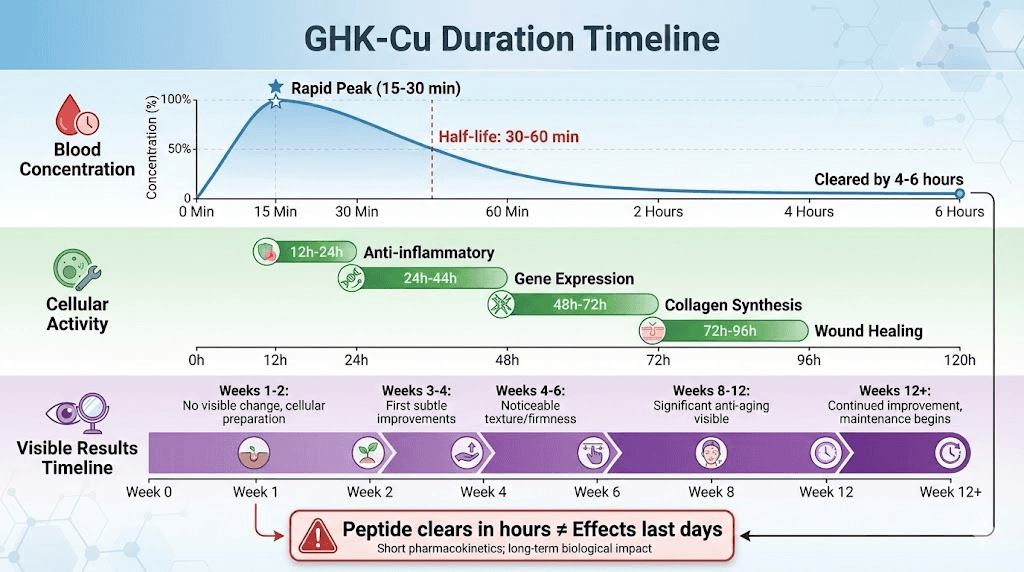
In consumer reports, any noticeable changes (if they happen) are often described over roughly 7–14 days, with plateaus possible thereafter. Individual response varies, and improvements may be subtle—comfort and mobility rather than dramatic repair.
What side effects should I watch for with GHK-Cu, BPC-157, TB-500 Wolverine Stack dosage?
Commonly reported issues in informal discussions include headaches, sleep disruption, mild GI discomfort, and local irritation (for injection routes). If symptoms are severe, persistent, or worsening, stop and seek medical advice.
Can I combine GHK-Cu, BPC-157, TB-500 Wolverine Stack dosage with training, creatine, or standard supplements?
Many people combine peptides with common training supplements, but there’s no universal rule that combinations are safe for everyone. The practical consumer approach is to keep other variables consistent, introduce changes one at a time, and watch for confounding effects in your tracking.
What’s the difference between oral vs injection GHK-Cu, BPC-157, TB-500 Wolverine Stack dosage or alternatives?
Injection subcutaneous dosing is generally more comparable route-to-route for calculation purposes, assuming accurate concentration and sterile handling. Oral/topical alternatives can be less standardized, with more variability in absorption and product formulation. That doesn’t automatically make them “worse,” but it does make dosage equivalence harder to judge.
A Practical 2-Week Experiment Framework
If you want a clean way to approach a GHK-Cu, BPC-157, TB-500 Wolverine Stack dosage guide without overcommitting, run a short, structured test. This isn’t a medical plan—just a consumer framework to reduce guesswork.
Day 0 (setup):
- Choose one goal metric: pain during a specific movement, range of motion, or training tolerance.
- Measure baseline: 0–10 pain, a simple mobility benchmark, and sleep hours.
- Confirm product concentration math and how you’ll split doses (if applicable).
Days 1–3 (start low + observe):
- Use the most conservative routine you’re comfortable with for your product labels.
- Keep training volume modest and avoid “testing” the injury aggressively.
- Track sleep and any headaches or GI changes.
Days 4–10 (stability check):
- Look for consistency, not spikes. A small decrease in daily pain can matter.
- Don’t change multiple variables at once. If you add something else, note it.
Days 11–14 (decision point):
- If you see no meaningful comfort or mobility change by the end of the window, treat it as a “no signal” result for this cycle.
- If you get side effects (especially sleep disruption or persistent headaches), stop and reassess.
Stop rules (simple and non-negotiable): persistent worsening symptoms, severe adverse effects, or any allergic-like signs. Also stop if you realize you can’t reliably measure what’s changing.
About the Author
Jordan Blake is a fitness and supplement workflow reviewer based in the US, with 6+ years of experience documenting training-related product trials (injury-aware mobility work, strength maintenance, and structured self-monitoring). Their consumer review style emphasizes dose math, labeling accuracy, and outcome tracking over hype. This article is for informational purposes only and does not constitute medical advice. Peptides discussed here are treated as experimental consumer products; always prioritize evidence-based care and consult a qualified healthcare professional for injury evaluation and any safety concerns.
Discussion